Picture this: You've just delivered what felt like an amazing leadership workshop. The energy was high, participants were engaged, and those end-of-session evaluations came back glowing. "Best training ever!" they wrote. "Really inspiring!" But three months later, you're sitting in a budget meeting where someone asks the dreaded question: "What's the actual ROI on our training investment?"
If you're like most professional development trainers, that moment makes your stomach drop. Because while you know your training makes a difference, proving it with concrete data is another story entirely.
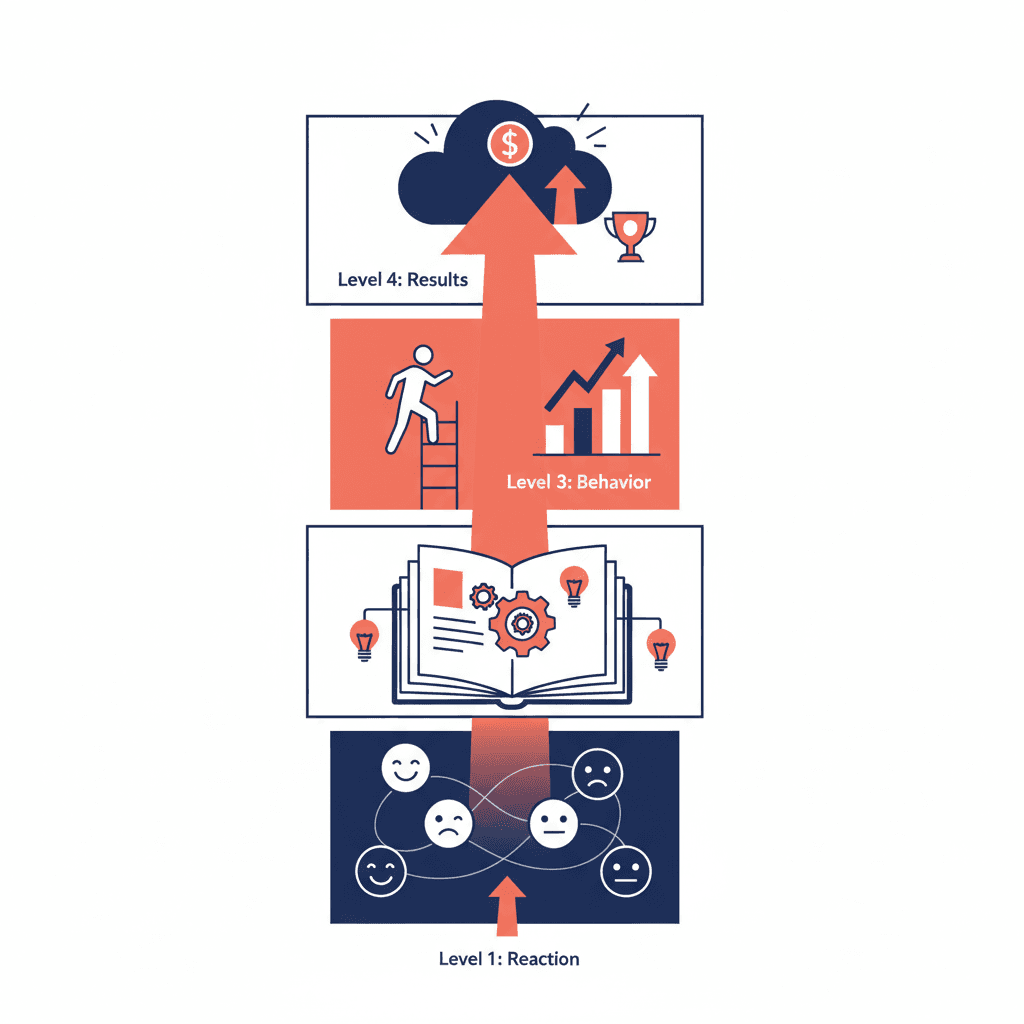
This is where Donald Kirkpatrick's Four Levels of Training Evaluation becomes not just helpful, but essential. Developed in the 1950s and refined over decades, this model provides a systematic framework for measuring training effectiveness that goes far beyond those "smile sheets" we've all come to rely on.
Why Most Training Evaluation Falls Short
Let's be honest about the current state of training evaluation. According to the Association for Talent Development's 2023 State of the Industry report, while 92% of organizations evaluate training at Level 1 (reaction), only 37% measure at Level 3 (behavior change), and a mere 12% attempt Level 4 (results) evaluation.
This creates a massive blind spot. We're measuring happiness instead of impact, satisfaction instead of transformation. It's like judging a restaurant only by how friendly the server was, ignoring whether the food was actually good or nutritious.
The consequence? Training departments struggle to justify budgets, demonstrate value, and continuously improve their offerings. Meanwhile, organizations continue investing in programs that may or may not be moving the needle on business outcomes.
Understanding Kirkpatrick's Four Levels: A Practical Framework
Let's break down each level with practical, real-world applications that you can implement immediately.
Level 1: Reaction - Beyond the Smile Sheet
What it measures: Participant satisfaction and engagement
Traditional Level 1 evaluation asks surface questions like "Did you enjoy the training?" But effective Level 1 evaluation digs deeper:
Smart Level 1 Questions:
- How relevant was this content to your current role challenges?
- What specific concepts will you apply within the next 30 days?
- How likely are you to recommend this training to colleagues facing similar challenges?
- What barriers might prevent you from applying what you learned?
Pro tip: Use a mix of quantitative scales and open-ended questions. The quantitative data gives you benchmarks; the qualitative responses provide actionable insights for improvement.
Real example: After a communication skills workshop, instead of asking "Rate your satisfaction 1-10," ask "Which communication technique addresses your biggest current workplace challenge, and how will you use it this week?"
Level 2: Learning - Measuring Knowledge and Skill Acquisition
What it measures: Knowledge gained, skills developed, attitudes shifted
This level confirms that participants actually absorbed the content and can demonstrate new capabilities. Effective Level 2 evaluation uses multiple assessment methods:
Assessment Strategies:
- Pre/post knowledge assessments: Measure knowledge gain with specific, scenario-based questions
- Skill demonstrations: Have participants practice new techniques during training
- Case study analysis: Present realistic scenarios requiring application of new concepts
- Peer teaching: Ask participants to explain concepts to colleagues
Implementation example: In a project management training, rather than testing memorization of project phases, present a realistic project scenario and have participants create a project plan using the methodologies taught.
Level 3: Behavior - Where Rubber Meets Road
What it measures: On-the-job application of learning
This is where many training programs succeed or fail in the real world. Level 3 evaluation requires follow-up beyond the training event itself.
Measurement Methods:
- 360-degree feedback: Collect input from supervisors, peers, and direct reports
- Observation protocols: Structured workplace observations of new behaviors
- Self-reporting tools: Detailed action planning and progress tracking
- Manager coaching conversations: Structured discussions about application
Timeline considerations: Measure at multiple intervals—30 days, 90 days, and 6 months post-training. Behavior change takes time and reinforcement.
Case study: A manufacturing company implementing safety leadership training tracked supervisor safety conversations. They measured frequency, quality, and employee response rates, discovering that while conversations increased initially, they dropped off after 60 days without ongoing reinforcement.
Level 4: Results - Connecting Learning to Business Impact
What it measures: Business outcomes and organizational benefits
This level links training directly to organizational metrics that matter to stakeholders.
Key Performance Indicators might include:
- Productivity measures: Sales figures, production rates, quality metrics
- Employee engagement: Retention rates, engagement scores, promotion rates
- Customer satisfaction: Service ratings, complaint reduction, repeat business
- Financial metrics: Revenue growth, cost reduction, profit margins
Critical success factors for Level 4:
- Establish baseline measurements before training begins
- Control for other variables that might influence results
- Allow sufficient time for results to manifest (typically 6-12 months)
- Use multiple data sources to strengthen your case
Implementing the Four Levels: A Step-by-Step Approach
Before Training: Set the Foundation
1. Define Clear Objectives
Start with the end in mind. What specific business problem are you solving? What behaviors need to change? What results do you expect to see?
2. Establish Baselines
Collect pre-training data across all four levels. This gives you comparison points and strengthens your impact story.
3. Design Assessment Tools
Create evaluation instruments for each level before you deliver training. This ensures alignment between content and measurement.
During Training: Embed Evaluation
1. Level 1 & 2 Integration
Build assessment naturally into the learning experience rather than tacking it on at the end.
2. Create Action Plans
Help participants identify specific applications and potential barriers while they're still in learning mode.
3. Establish Accountability
Set up follow-up commitments and check-in processes before participants leave.
After Training: Follow Through
1. Scheduled Follow-ups
Don't let evaluation be a one-time event. Schedule regular check-ins at predetermined intervals.
2. Manager Engagement
Involve supervisors in the evaluation process. They're critical for supporting behavior change and can provide valuable observational data.
3. Continuous Improvement
Use evaluation data to refine and improve your training programs continuously.
Overcoming Common Implementation Challenges
Challenge 1: "We Don't Have Time for Extensive Evaluation"
Solution: Start small and build incrementally. Begin with enhanced Level 1 evaluation, then gradually add levels as you demonstrate value.
Challenge 2: "Management Doesn't See the Value"
Solution: Connect evaluation results to business metrics they already track. Speak their language—ROI, productivity, retention.
Challenge 3: "Participants Don't Complete Follow-up Surveys"
Solution:
- Keep surveys short and focused
- Explain the "why" behind evaluation
- Use multiple touchpoints rather than one long survey
- Consider incentives or make participation part of the learning journey
Challenge 4: "Too Many Variables Affect Results"
Solution: Use control groups when possible, acknowledge limitations, and focus on correlation rather than absolute causation.
Technology Tools That Support Kirkpatrick Implementation
Modern learning management systems and survey platforms can streamline Kirkpatrick evaluation:
- Learning Management Systems: Track engagement, completion rates, and assessment scores
- Survey Platforms: Automate follow-up surveys and data collection
- Performance Management Tools: Connect learning outcomes to performance reviews
- Analytics Dashboards: Visualize data across all four levels
Making Your Case: Communicating Results to Stakeholders
When presenting evaluation results:
1. Start with Business Impact
Lead with Level 4 results when available, then work backward through the levels to tell a complete story.
2. Use Visual Data
Charts, graphs, and infographics communicate impact more effectively than dense reports.
3. Share Participant Stories
Combine quantitative data with qualitative testimonials that illustrate transformation.
4. Acknowledge Limitations
Be transparent about what you can and cannot definitively prove. This builds credibility.
The Future of Training Evaluation
As we move forward, several trends are shaping how we think about training evaluation:
- Real-time feedback: Mobile apps and digital platforms enable continuous data collection
- Predictive analytics: AI helps identify which participants are most likely to apply learning
- Micro-learning assessment: Shorter, more frequent evaluation touchpoints
- Social learning metrics: Measuring peer-to-peer knowledge sharing and collaboration
Your Next Steps: From Smile Sheets to Strategic Impact
Kirkpatrick's Four Levels model isn't just an academic framework—it's a practical roadmap for demonstrating the real value of your professional development work. Here's how to get started:
This week:
- Review your current evaluation practices across all four levels
- Identify one training program where you can enhance evaluation
- Design better Level 1 questions that predict future application
This month:
- Implement Level 2 assessments that measure actual learning
- Set up systems for Level 3 follow-up evaluation
- Begin collecting baseline data for Level 4 metrics
This quarter:
- Conduct your first comprehensive four-level evaluation
- Present results to key stakeholders
- Use findings to improve future programming
The training industry is evolving rapidly, and organizations are demanding greater accountability for their L&D investments. Those who can demonstrate genuine impact—not just satisfaction—will thrive in this environment.
Your expertise as a trainer is valuable. Now it's time to prove it with data that matters. Because when you can show that your training doesn't just make people happy—it makes them better, more effective, and more valuable to their organizations—you transform from a cost center into a strategic partner.
What training program will you evaluate next? The business case for your continued success depends on the answer.